Reiki Healing for Life Transitions: Supporting Your Nervous System Through Change
Life has a way of asking us to evolve, to adapt, to become someone new.
Sometimes that invitation arrives through pregnancy and birth. Sometimes through loss, a career change, the end of a relationship, a move, or a season of personal transformation. Even when change is welcomed, it often brings uncertainty. The familiar begins to fall away before the new has fully arrived, leaving us suspended somewhere in between.
These in-between spaces can be deeply uncomfortable. We may find ourselves feeling anxious, exhausted, emotionally reactive, disconnected from our bodies, or simply overwhelmed by the number of decisions we need to make. While we often think of these experiences as emotional challenges, they are also nervous system experiences.
Our nervous systems are constantly scanning for cues of safety, familiarity, and predictability. During periods of transition, many of those anchors shift. The result can be a nervous system that feels stretched beyond its usual capacity as it works to adapt to new circumstances.
This is one reason many people seek out Reiki during times of change.
What Is Reiki?
Reiki is a gentle energy healing practice that originated in Japan. The word Reiki is often translated as "universal life energy," and the practice is based on the understanding that this life force energy flows through all living things.
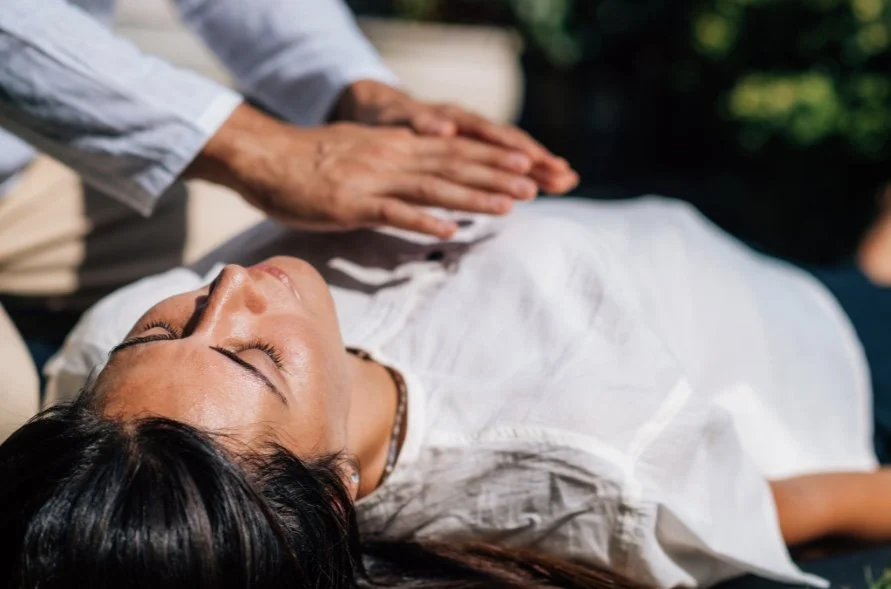
During a Reiki session, the practitioner places their hands lightly on or just above the body, creating a space that supports relaxation, presence, and energetic balance. While experiences vary from person to person, many people describe feeling deeply relaxed, grounded, and connected after a session.
Some experience warmth, tingling sensations, emotional release, or a sense of clarity. Others simply notice that their minds become quieter and their bodies feel less burdened by the weight they have been carrying.
The experience itself is often less about fixing something and more about creating the conditions for the body and mind to settle into a state where healing and integration can naturally occur.
Reiki and the Nervous System
When people hear the phrase "nervous system regulation," they often imagine that the goal is to become calm as a state to maintain. But the truth is, a healthy nervous system is not one that remains permanently relaxed. A healthy nervous system is flexible. It can respond to challenge when needed and return to a state of balance when the challenge has passed.
The real goal is not constant calm. It is greater capacity.
Capacity allows us to experience stress without becoming consumed by it. It allows us to move through difficult emotions without feeling trapped in them. It allows us to navigate uncertainty without losing our connection to ourselves. By creating the conditions that support healing, Reiki plays a valuable role in building this capacity by signaling our body and mind that our system holds safety.
Reiki can support this process by offering an environment that encourages the nervous system to soften its protective responses. Reiki interacts with the body by shifting from the sympathetic (“fight or flight”) state into the parasympathetic (“rest and digest”) state. The gentle, non-invasive touch and focused presence of a Reiki practitioner stimulate the vagus nerve. This cranial nerve is the master regulator of the parasympathetic nervous system, responsible for slowing the heart rate, lowering blood pressure, and reducing stress hormones like cortisol. In the stillness of a session, many people notice their breathing slow, their muscles release tension, and their minds become less occupied by the endless demands of daily life.
This pause can be especially meaningful during life transitions, when the nervous system may be working overtime to adapt to change.
Supporting the Space Between What Was and What Is Becoming
One of the most challenging aspects of transition is that we often want certainty before it is available. We want answers before the path becomes clear. We want reassurance that everything will work out. We want to know who we will be on the other side. Yet growth rarely unfolds that way.
There is often a period where the old version of life no longer fits and the new version has not yet fully emerged. This space can feel vulnerable, disorienting, and deeply human.
Reiki offers an opportunity to be with that uncertainty rather than immediately trying to solve it. Instead of pushing for answers, the practice invites presence. Instead of trying to figure everything out, it creates room to reconnect with what is happening beneath the surface. For many people, this alone becomes profoundly supportive.
Reiki During times of Transition
I often see people drawn to Reiki during seasons that stretch them beyond their usual coping strategies. Pregnancy and postpartum, grief and loss, career changes, relationship transitions, caregiving responsibilities, and periods of spiritual or personal growth can all place unique demands on the nervous system. This kind of ongoing stress keeps the body in a state of hyper-arousal known as “fight or flight”.
While the circumstances may differ, the common thread is often the same: something significant is changing, and the body is being asked to adapt, to hold more, to release that which no longer serves.
Reiki cannot remove the challenges that come with transition but it will offer a space to slow down long enough to hear ourselves again. And within that space, our body is reminded what safety feels like and that it is something we can return to.
In a culture that often encourages constant productivity and forward motion, that pause can be profoundly healing.
A Holistic Approach to Healing
Reiki is not intended to replace medical care, therapy, or other forms of support. Rather, it can be part of a holistic approach to well-being that honors the interconnected nature of mind, body, emotions, and spirit.
Many people find Reiki complements practices such as therapy, somatic work, meditation, breathwork, journaling, or mindful movement. Together, these approaches can help build the resilience needed to navigate life's inevitable changes.
Healing is rarely about finding a single solution. More often, it is about creating enough support that we can meet ourselves with greater awareness and compassion as life unfolds.
Finding Stability Within Change
Life transitions are often portrayed as destinations. We focus on the birth, the move, the new job, the healed relationship, or the next chapter.
But much of our growth happens in the space between. Reiki offers an invitation to slow down and meet yourself there.
Sometimes healing is not about changing your circumstances. Sometimes it begins by creating enough space within yourself to navigate those circumstances with greater presence, resilience, and trust.
Reiki is offered as a stand alone service or can be added to your somatic coaching (Threshold Weaver) experience. Both of these offerings complement one another and support you wherever you are in your in~between.